security Crypto's Bloodiest Half-Year: 212 Exploits Stole $1.1B as AI-Powered Attacks Go Mainstream Blockaid's H1 2026 report reveals 212 onchain exploits draining $1.1B from Web3 protocols. North Korea's Lazarus Group drove over $600M in losses, and AI prompt injection attacks are emerging as the next major threat vector. Here's what every builder needs to know.
ai-agents AI Agents Can Now Pay on Your Behalf: Moonpay PayBox Explained Moonpay's PayBox lets ChatGPT and Claude execute real crypto transactions from a conversation — no terminal, no developer tools, no handing over private keys. Here is how the infrastructure works and what it means for web3 developers building for the AI agent economy.
regulation Asia's Crypto Rulebook Takes Shape as Hong Kong OKs XRP and Korea Drafts Landmark Law On July 29, 2026, Hong Kong opened retail XRP trading through OSL Group while South Korea advanced its Digital Asset Basic Act. Here is what Asia's crypto regulatory divergence means for developers and the global market.
institutional Morgan Stanley Debuts Cheapest ETH and SOL ETFs With Staking Morgan Stanley launched spot Ethereum and Solana ETFs at 0.14% - the cheapest in the US market - with staking rewards flowing directly to investors from day one. Here's why it's a turning point for institutional crypto adoption and what it means for web3 builders.
ethereum Ethereum ETFs Surpass Bitcoin in Weekly Institutional Flows For the third time in 2026, Ethereum ETFs have attracted more weekly institutional capital than Bitcoin — and the gap is widening. Here's what's driving the rotation.
RWA Robinhood Chain Surpasses Solana in Tokenized Stock Trading Volume Robinhood Chain overtook Solana in tokenized stock trading volume just three weeks after launch, amassing $70M in onchain equities. Here's what the breakout means for the future of tokenized finance.
regulation CLARITY Act 2026: Senate Vote Guide for Web3 Developers The 616-page CLARITY Act merged text includes the strongest developer protections in US crypto law. Here's what the Senate vote means for Web3 builders.
ethereum Lido $16.5B ETH Migration Reshapes Ethereum Staking Lido begins the largest Ethereum staking migration in history, consolidating $16.5 billion in staked ETH onto post-Pectra validators and introducing ETH bonds for professional node operators.
ethereum Ethereum Staking at All-Time High as Exit Queue Hits Zero Ethereum's validator exit queue just hit zero for the first time, with 41M ETH staked and 2.48M more waiting to enter. Combined with Morgan Stanley's staking ETF clearing the SEC, the supply dynamics are shifting fast. Here's what developers and builders need to know.
perp-dex Perp DEX Infrastructure: How Order Books Are Winning Onchain Decentralized perpetuals now process $750M+ daily as purpose-built order book chains overtake AMM-based models. Here's what the infrastructure shift means for builders.
depin DePIN Isn't Dead: Why the 83% Token Crash Hides a Developer Boom DePIN tokens crashed 83%. Headlines are calling it dead. But underneath the carnage, real usage is surging: 428% growth on Akash, 1,170 active projects, and AI demand that won't slow down. Here's what developers need to know.
stablecoins Stablecoin Exchange Reserves Drop $2.3B: What the Liquidity Crunch Means for Web3 Builders Binance and Bybit shed $2.3 billion in stablecoins over 30 days, and total USD stablecoin supply contracted by $5 billion in the largest monthly decline since Terra-Luna. Here is why shrinking exchange liquidity matters for every web3 builder, from token launches to DeFi protocol design.
security Allbridge Core Exploit: What the $1.65M Flash Loan Attack Means for Cross-Chain Security Allbridge Core paused its protocol after a $1.65 million flash loan exploit on Solana. Learn how the attack manipulated stablecoin pool ratios in a single transaction, why cross-chain bridges remain the most targeted crypto infrastructure, and what developers must do to protect users.
web3 Web3 Gaming Infrastructure: A Developer's Guide to Blockchain Game Engines The web3 gaming market reached $48.55 billion in 2026 with a 22.4% growth rate. Compare blockchain game engines and SDKs — Sequence, thirdweb, Immutable, and MUD — to choose the right infrastructure stack for your game studio.
tokenization Fidelity FILQ Tokenized Fund Brings $7B Model to Ethereum Fidelity International launched FILQ, a tokenized money market fund on Ethereum rated AAA-mf by Moody's. With Chainlink-powered NAV feeds and 24/7 stablecoin settlement, it signals institutional tokenization moving from concept to production infrastructure.
ethereum Ethereum Fusaka Upgrade: 8x Blob Capacity Reshapes L2 Scaling Ethereum just shipped Fusaka, its second major upgrade of 2026. The centerpiece is PeerDAS — a data availability sampling technique that lets L2s post 8x more blob data without raising node requirements. Here is what changed and why it matters for every builder on Arbitrum, Base, and Optimism.
ethereum Base B20: Protocol-Level Tokens Without Smart Contracts Coinbase's Base L2 just shipped the B20 native token standard — a Rust precompile that replaces ERC-20 smart contracts with protocol-level logic, built-in compliance controls, and zero deployment overhead. Here's what it means for web3 developers building tokens in 2026.
ai-agents Ledger Agent Stack: Hardware-Gated Wallet Security for AI Agents Ledger open-sourced its Agent Stack, letting AI agents interact with crypto wallets but requiring hardware approval for every transaction. With over 1,000 agents tested and production integrations already live, it is the first standardized security framework for AI agent finance.
ethereum ETRADE Crypto Trading Goes Live: What Morgan Stanley's Spot BTC, ETH, SOL Move Means for Web3 Morgan Stanley launched spot BTC, ETH, and SOL trading on E*TRADE at 50bps, undercutting Coinbase. Here's how the Zero Hash custody architecture works and what transfers later this year mean for web3 builders.
stablecoins GENIUS Act Deadline: What the $309B Stablecoin Rulebook Means for Web3 Builders The GENIUS Act July 18 rulemaking deadline arrives tomorrow with no coordinated final rules across seven federal agencies. For web3 developers, the framework determines which stablecoins circulate legally, what reserves back them, and how onchain applications must adapt.
stablecoins Visa Stablecoin Platform: What It Means for Web3 Developers Visa just opened its global payment network to stablecoin-native money movement. The new Visa Stablecoin Platform gives banks and fintechs the tools to issue, hold, and transfer digital dollars — and it changes the game for every web3 developer building on payment rails.
security KelpDAO Bridge Exploit: Security Lessons for DeFi Builders The KelpDAO bridge exploit wasn't a smart contract bug — it was a single misconfiguration that allowed attackers to mint $292 million in unbacked rsETH. Here's what every DeFi builder must learn from the largest exploit of 2026.
nft Onchain Gacha Hits $324 Million While Crypto Tanked Tokenized trading card platforms hit a record $324.6 million in June spending — a sixfold increase from a year ago — even as Bitcoin plunged 20%. Inside the onchain gacha boom that's reshaping how collectors buy, trade, and redeem physical assets on blockchain rails.
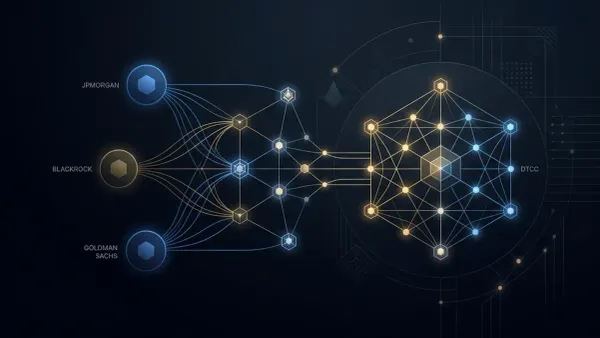
tokenization Wall Street's $4.7 Quadrillion Clearinghouse Just Went Onchain: DTCC Tokenizes Stocks With BlackRock, JPMorgan, and Goldman Sachs The DTCC completed its first live tokenized securities trades on July 15, 2026, with BlackRock, JPMorgan, Goldman Sachs, Vanguard, and the NYSE. The full tokenization service launches in October — here's what happened and why it changes everything.
mev MEV Survival Guide: How Builders Defend Against Sandwich Attacks in 2026 The $7.5M JaredfromSubway exploit was a wake-up call for DeFi builders. Learn how the MEV supply chain works under PBS, why sandwich attacks remain the invisible tax on users, and the full-stack defense strategies that protect your protocol.