
Perp DEX Infrastructure: How Order Books Are Winning Onchain
Decentralized perpetuals now process $750M+ daily as purpose-built order book chains overtake AMM-based models. Here's what the infrastructure shift means for builders.

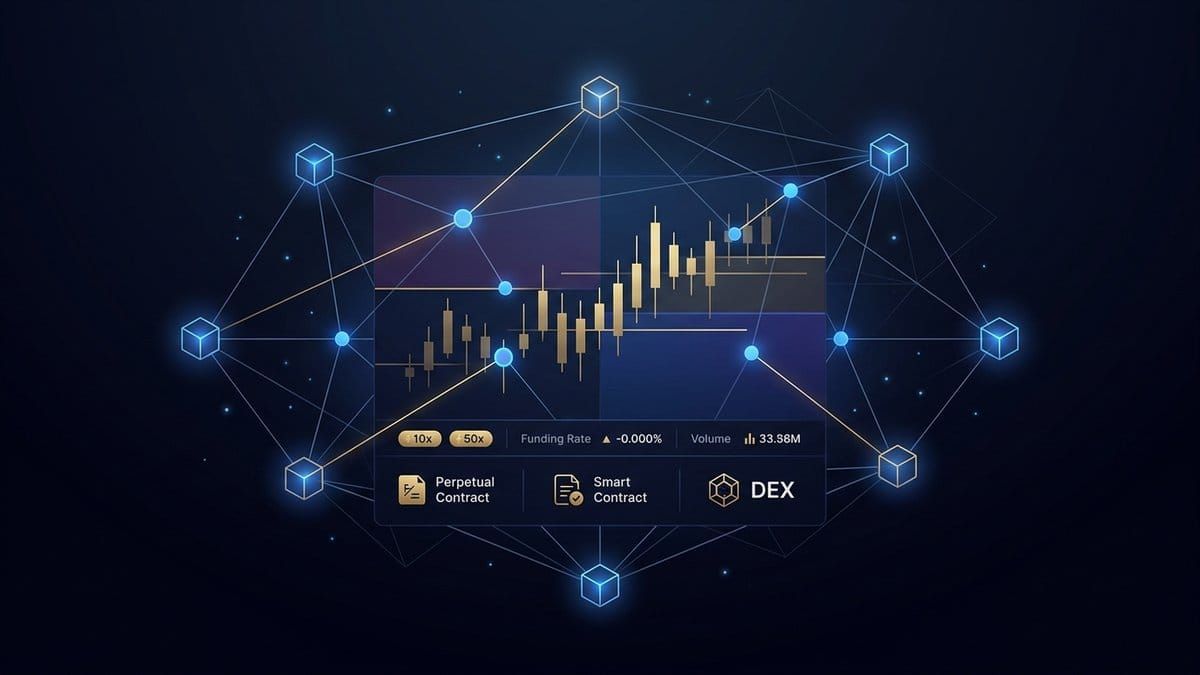
The $750M Daily Shift No One's Talking About
The decentralized perpetuals market now processes over $750 million in daily volume as a sector. But that headline number understates what's actually happening. One protocol, Hyperliquid, regularly handles between $3 billion and $7 billion in daily notional volume according to onchain data from Dune Analytics. That means a single venue captures between 50% and 70% of all onchain derivatives flow, a concentration of market share without precedent in DeFi history.
Hyperliquid's HYPE token crossed a $15.5 billion market cap in July 2026, placing it inside the CoinGecko global top 10, ahead of assets with multi-year head starts like Cardano and Shiba Inu. The protocol has generated over $1.25 billion in cumulative fees serving 1.2 million users whose combined transaction volume exceeds $4.78 trillion.
These numbers aren't just a bull market flex. They signal a structural shift in how onchain trading infrastructure is being built, valued, and used. The AMM-based model that defined DeFi's first derivatives wave is losing ground to purpose-built order book chains. For developers building the next generation of financial applications, understanding why matters.
Why AMMs Lost the Perpetuals War
Most decentralized perpetuals protocols before Hyperliquid operated on an Automated Market Maker model. GMX, dYdX v3, and early Gains Network all routed trades through liquidity pools rather than a central limit order book. The approach worked for smaller trades but broke down at scale.
AMMs introduce slippage that grows with order size. A $500,000 position that costs 0.05% on a centralized exchange might cost 0.3% or more on an AMM-based perp DEX once price impact is factored in. That gap is large enough to destroy the economics of systematic trading strategies. Professional market makers, who provide the liquidity depth that attracts institutional flow, found AMM-based venues too expensive to quote on profitably. The result was a self-reinforcing cycle: thin liquidity led to higher slippage, which drove away larger traders, which kept liquidity thin.
The order book model solves this differently. By matching buyers and sellers directly on a central limit order book, Hyperliquid achieves sub-100-millisecond latency with taker fees of 0.035% and maker rebates of 0.01%, a fee structure identical to the maker-taker models used by professional centralized venues. For traders who had accepted latency penalties as the cost of onchain self-custody, that penalty effectively disappeared.
The competitive evidence is now in: dYdX v4, which migrated to its own Cosmos-based chain in 2023 specifically to achieve order book performance, has struggled with validator participation and liquidity depth. As of mid-2026, DefiLlama data consistently places dYdX's daily volume at a fraction of Hyperliquid's, a complete reversal of the ordering that held as recently as early 2024. Architecture alone wasn't enough, execution and ecosystem incentives mattered just as much.
Inside Hyperliquid's Developer Stack
Hyperliquid's architecture consists of three layers sharing a single unified state: HyperBFT for consensus, HyperCore as the native trading engine, and HyperEVM as the smart contract environment. The shared state is what makes the platform uniquely interesting for builders, a HyperEVM application can read HyperCore oracle prices directly, and contracts can interact with the same order books that process billions in daily volume.
HyperCore is the financial engine. Perpetual futures, spot markets, vaults, oracle infrastructure, and outcome contracts all live here. It's where liquidity, trading activity, and market data originate. HyperEVM is the programmable layer, supporting Solidity applications with standard Ethereum tooling including Foundry, Hardhat, Ethers.js, and Web3.js without modification.
Three developer-facing features deserve particular attention. First, builder codes let applications monetize order flow directly: any app routing trades through Hyperliquid can attach and collect a fee of up to 10 basis points on perps and 1% on spot, with over $65 million already paid to third-party developers. Second, HIP-3 introduced permissionless perpetual market deployment: developers stake 500,000 HYPE, configure an oracle, and launch a perp market with its own order book and collateral. Third, HIP-4 added fully collateralized outcome contracts in May 2026, supporting binary and multi-price prediction markets settled in USDH on the same order book infrastructure as the perpetuals exchange.
When SpaceX went public in June 2026, a third-party team deployed the SPCX perpetual on Hyperliquid, and it did $1.34 billion in volume on IPO day. That speed of market creation, from idea to live trading in hours, is something no traditional exchange can match.
What This Means for Builders in 2026
The implications for developers building onchain financial applications are significant. Historically, launching a DeFi protocol meant bootstrapping liquidity, users, and applications simultaneously. Building on a venue where active markets already exist changes the starting position entirely.
Three categories of applications are emerging. Trading applications are the most mature: custom frontends, portfolio dashboards, broker experiences, and wallet-native trading interfaces that route activity through Hyperliquid's order books. Market intelligence products, powered by real-time access to funding rates, liquidation events, vault performance, and trade activity, are enabling research terminals and institutional analytics platforms. And new market creation, through HIP-3 perps and HIP-4 outcome contracts, lets teams launch financial products without building exchange infrastructure from scratch.
The broader landscape is also evolving. On Solana, protocols like Drift and Zeta are pursuing order book models optimized for the chain's high throughput. On EVM L2s, GMX v2 has deepened integration with Arbitrum's native sequencer and Chainlink's low-latency oracles to narrow the latency gap. The takeaway for builders isn't to pick one chain, but to understand the architectural tradeoffs that now define perp DEX infrastructure and build where the liquidity lives.
If you're ready to build onchain trading applications or DeFi protocols, thirdweb's smart contract SDKs provide the infrastructure to deploy across EVM chains, Solana, and beyond. From pre-built contracts for token launches and staking to full-stack development tooling, thirdweb offers plans that scale with your project at every stage.
The Road Ahead: Risks, Regulation, and the EVM Frontier
Hyperliquid's dominance is real but not risk-free. The validator set remains more concentrated than comparable L1 networks, a deliberate tradeoff for latency that independent research identifies as a distinct systemic risk for financial applications. Regulatory exposure is another concern: the CFTC has a documented enforcement pattern against unregistered onchain derivatives venues, and Hyperliquid's material U.S. person participation creates a compliance overhang shared across the sector.
The HyperEVM layer, while promising, remains in early stages. Over 100 protocols are live, but the full impact on protocol revenue and developer adoption will take several quarters to measure. The vision of Hyperliquid as a financial operating system rather than just an exchange depends on HyperEVM succeeding as a development platform.
Zooming out, the directional trend is unmistakable. Onchain venues now capture an estimated 5% to 8% of total crypto derivatives volume, up from under 2% in early 2023 according to a16z crypto's State of Crypto report. Centralized exchanges still dominate in absolute terms, Binance alone reports over $50 billion in daily perpetuals volume. But the share is shifting by basis points every quarter, and the architectural innovations that made Hyperliquid possible are being replicated and improved upon across the ecosystem.
The perp DEX infrastructure playbook is being written in real time. Purpose-built chains, order book architectures, shared-state programmability, and developer incentive mechanisms are the building blocks. The protocols that combine them effectively won't just capture market share from centralized venues, they'll define the next generation of financial infrastructure.