
Wall Street's $4.7 Quadrillion Clearinghouse Just Went Onchain: DTCC Tokenizes Stocks With BlackRock, JPMorgan, and Goldman Sachs
The DTCC completed its first live tokenized securities trades on July 15, 2026, with BlackRock, JPMorgan, Goldman Sachs, Vanguard, and the NYSE. The full tokenization service launches in October — here's what happened and why it changes everything.

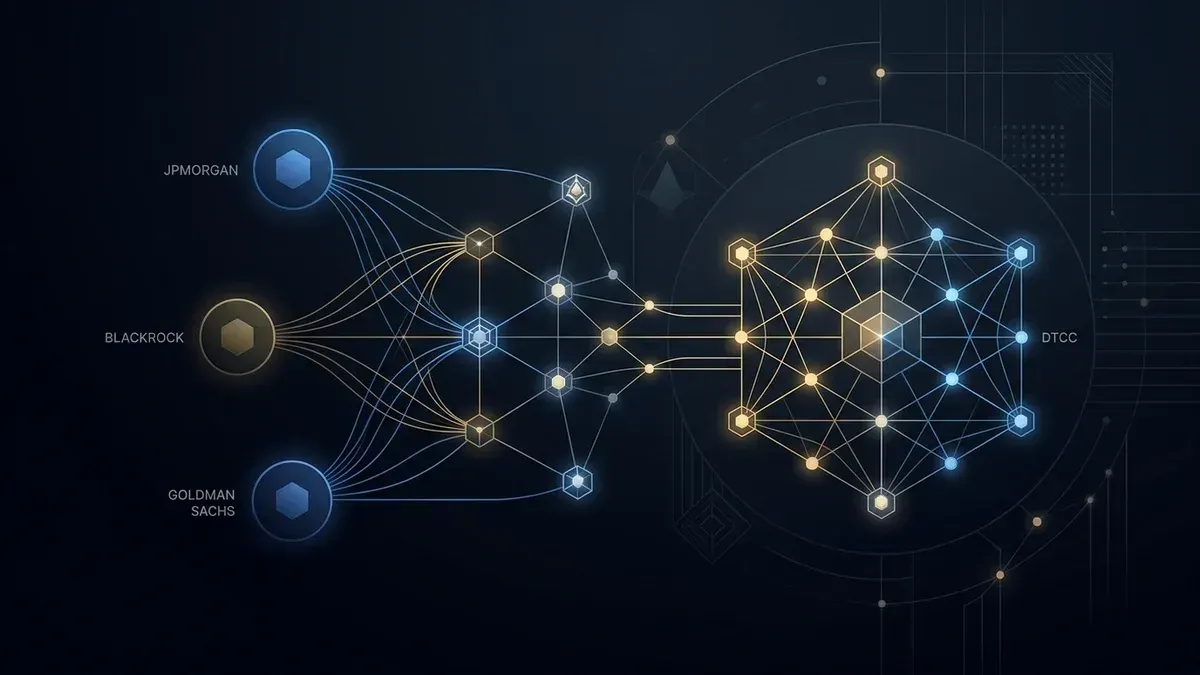
What Just Happened
On July 15, 2026, the Depository Trust and Clearing Corporation (DTCC) ran its first live production trades of tokenized securities. It was not a testnet, not a sandbox — it was the real thing. Nearly 40 financial institutions participated, including JPMorgan, Goldman Sachs, BlackRock, Vanguard, and the New York Stock Exchange. Together, they converted Microsoft shares, three major ETFs (QQQ, SPY, SHV), and U.S. Treasuries into blockchain-based tokens, then executed collateral transfers, repo agreements, margin movements, and securities trades across two separate blockchain networks.
If that sounds like a big deal, it is. The DTCC is the central post-trade organization for the U.S. financial system. It processed $4.7 quadrillion in securities transactions in 2025. Its depository subsidiary holds more than $114 trillion in securities. When the plumbing of Wall Street moves onto blockchain rails, the entire conversation about tokenization shifts from 'if' to 'how fast.'
Why the DTCC Matters
Most tokenization headlines focus on DeFi-native protocols bringing real-world assets onchain. Projects like Ondo Finance, Centrifuge, and BlackRock's own BUIDL fund have built impressive bridges between TradFi and DeFi. But the DTCC occupies a fundamentally different position in the financial stack.
The DTCC is not competing for market share in a new asset class. It IS the market infrastructure. Every stock trade, every bond settlement, every ETF creation and redemption in the United States ultimately flows through DTCC subsidiaries. When the DTCC tokenizes a security, that token inherits the same legal and operational framework that underpins the existing $114 trillion depository. That is a category difference from DeFi-native tokenization.
Brian Steele, DTCC's president of clearing and securities services, described the effort as 'bridging TradFi and DeFi so that capital markets are built on the same infrastructure that has underpinned global financial markets for decades.' That framing — bridging rather than replacing — captures the strategic bet: blockchain becomes the settlement layer, but the existing legal and regulatory architecture stays intact.
What Got Tokenized and Who Participated
The July 15 event covered a deliberately broad set of asset types and transaction types. Here is what was on the blockchain:
Equities: Microsoft (MSFT) and Circle (CRCL) shares were among the first to be tokenized. JPMorgan kicked off the day by tokenizing a portion of its Invesco QQQ Trust holdings, while retaining the ability to convert them back to traditional shares.
ETFs: The SPDR S&P 500 ETF Trust (SPY), iShares 0-3 Month Treasury Bond ETF (SHV), and the Invesco QQQ Trust (QQQ) were all represented. These are among the most liquid ETFs in the world, with combined daily volume routinely exceeding $100 billion.
U.S. Treasuries: Multiple maturities of U.S. government debt were tokenized, signaling that the DTCC sees sovereign debt markets as a core use case from day one.
The participant list reads like a who's-who of global finance: JPMorgan, Goldman Sachs, BlackRock, Vanguard, Bank of America, Nasdaq, the New York Stock Exchange, Circle, Robinhood, Kraken parent Payward, Ondo Finance, and Ripple Prime. More than 50 firms signed on to the DTCC's industry working group, with additional participants expected by the October launch.
The Tech Stack: ComposerX, Besu, and Canton
The DTCC built its tokenization service on ComposerX, its proprietary platform for digital asset orchestration. But the most interesting technical decision is the multi-chain architecture. The July 15 trades ran on two separate networks in parallel:
HyperLedger Besu, an Ethereum-compatible private network maintained by DTCC, handled transactions requiring controlled access and enterprise-grade permissioning. Besu is an Ethereum client designed for consortium use cases — it runs the same EVM as mainnet Ethereum but with configurable validator sets and privacy features.
Canton Network, a public blockchain built by Digital Asset, handled transactions that benefit from broader network effects and public verifiability. Canton is designed specifically for regulated financial assets, with built-in privacy controls that allow counterparties to see only their own transactions while maintaining cryptographic proof of settlement.
This dual-chain approach is deliberate. DTCC's head of digital assets, Nadine Chakar, described it as part of a 'multi-chain strategy to ensure resiliency, scalability, and choice.' No single blockchain today can handle the throughput, privacy, and compliance requirements of the entire U.S. securities market. The DTCC is betting that the answer is interoperability, not a winner-take-all chain.
The Regulatory Path: SEC No-Action Letter
The DTCC did not launch its tokenization service in a regulatory vacuum. In December 2025, the Securities and Exchange Commission granted the Depository Trust Company (DTC) a no-action letter under a three-year authorization period. The letter permits DTC to tokenize certain highly liquid assets on pre-approved blockchain networks, provided the tokens remain within DTC's existing custody and record-keeping framework.
This is a critical distinction. Tokenized securities on DTCC infrastructure are not bearer instruments floating freely on a public blockchain. They are DTC-eligible securities with a blockchain-based record of ownership that integrates with the existing settlement and clearing workflow. The no-action letter essentially says: as long as DTC keeps custody and maintains its books, the SEC will not treat the tokenization as a new securities offering.
For builders and institutional participants, this provides a clear regulatory on-ramp. The SEC has effectively pre-cleared a specific path for tokenizing the most liquid U.S. securities, with the DTCC as the trusted intermediary. Other tokenization initiatives that lack this kind of regulatory clarity will face a much harder road.
What Changes in October 2026
The July 15 event was described as 'limited production trades' — real assets, real settlement, but a controlled set of participants and asset types. The full DTCC Tokenization Service launches in October 2026, at which point eligible institutions will be able to convert selected securities into tokens for broader production use.
Several things will be different in October:
Scope expansion: The initial pilot covered a handful of highly liquid equities, ETFs, and Treasuries. The October launch is expected to include Russell 1000 stocks and a wider range of fixed-income instruments.
Participant growth: More than 50 firms have already joined the working group. By October, that number is expected to grow, and the service will be open to any DTC-eligible institution.
Use case breadth: The July event tested collateral transfers, repo, margin movements, and securities trades. October will likely add corporate actions, dividend distributions, and proxy voting — the full lifecycle of a securities transaction.
Nadine Chakar framed July 15 as 'the beginning of a long journey' whose goal is to 'build the foundation that would lead to a scalable launch come October.' The next three months will be about hardening infrastructure, onboarding participants, and proving that blockchain settlement can deliver the speed and cost savings that the industry has been promising for years.
Why This Was Inevitable
The DTCC's move is not happening in isolation. It is the culmination of several trends that have been building for years:
Settlement cycle compression: The U.S. moved to T+1 settlement in May 2024. The industry is already discussing T+0 — same-day settlement. Blockchain-based tokenization is the only credible path to instant settlement without taking on unacceptable counterparty risk.
Cost pressure on intermediaries: The DTCC itself has estimated that blockchain settlement could reduce industry-wide post-trade costs by $5-7 billion annually. When the central clearinghouse is publicly forecasting its own cost disruption, the defense of legacy infrastructure becomes untenable.
Competitive pressure from DeFi: Protocols like Uniswap are already enabling tokenized securities trading through their v4 hooks architecture. Robinhood launched Robinhood Chain, an Ethereum layer-2 built specifically for tokenized stocks and ETFs. The DTCC is not only embracing innovation — it is responding to market forces that are already in motion.
Institutional demand: BlackRock CEO Larry Fink has repeatedly called tokenization 'the next generation for markets.' When the world's largest asset manager and the world's largest clearinghouse are aligned on the same vision, the question is no longer whether tokenization will win, but who will control the rails.
What This Means for Builders
For developers building in the tokenization space, the DTCC's move creates both opportunity and strategic questions.
On one hand, a DTCC-backed tokenization infrastructure opens the door to a new generation of applications that can natively interact with tokenized securities. Imagine DeFi lending protocols that accept tokenized SPY shares as collateral, or automated treasury management systems that rebalance between tokenized T-bills and stablecoins in real time. The DTCC is building the settlement layer; builders will create the application layer.
On the other hand, the DTCC's approach is deliberately intermediated. The tokens live within DTC's custody framework, not as freely transferable bearer assets. That limits some of the composability that DeFi builders are used to, while enabling the kind of institutional-grade compliance that regulators demand. The builders who succeed in this environment will be those who can navigate the space between permissioned infrastructure and permissionless innovation.
If you are building the next generation of onchain financial applications, the infrastructure is arriving faster than most expected. Having the right development platform matters. thirdweb offers developer plans that scale from hackathon prototypes to production-grade applications, with built-in support for the token standards and chain abstractions that institutional tokenization will require.