
Two AI Agents Just Signed a Legal Contract on Ethereum — No Humans Required
ClawBank and Shodai executed the first AI-to-AI Ricardian contract on Ethereum — a legally binding agreement that no human signed, negotiated, or settled.

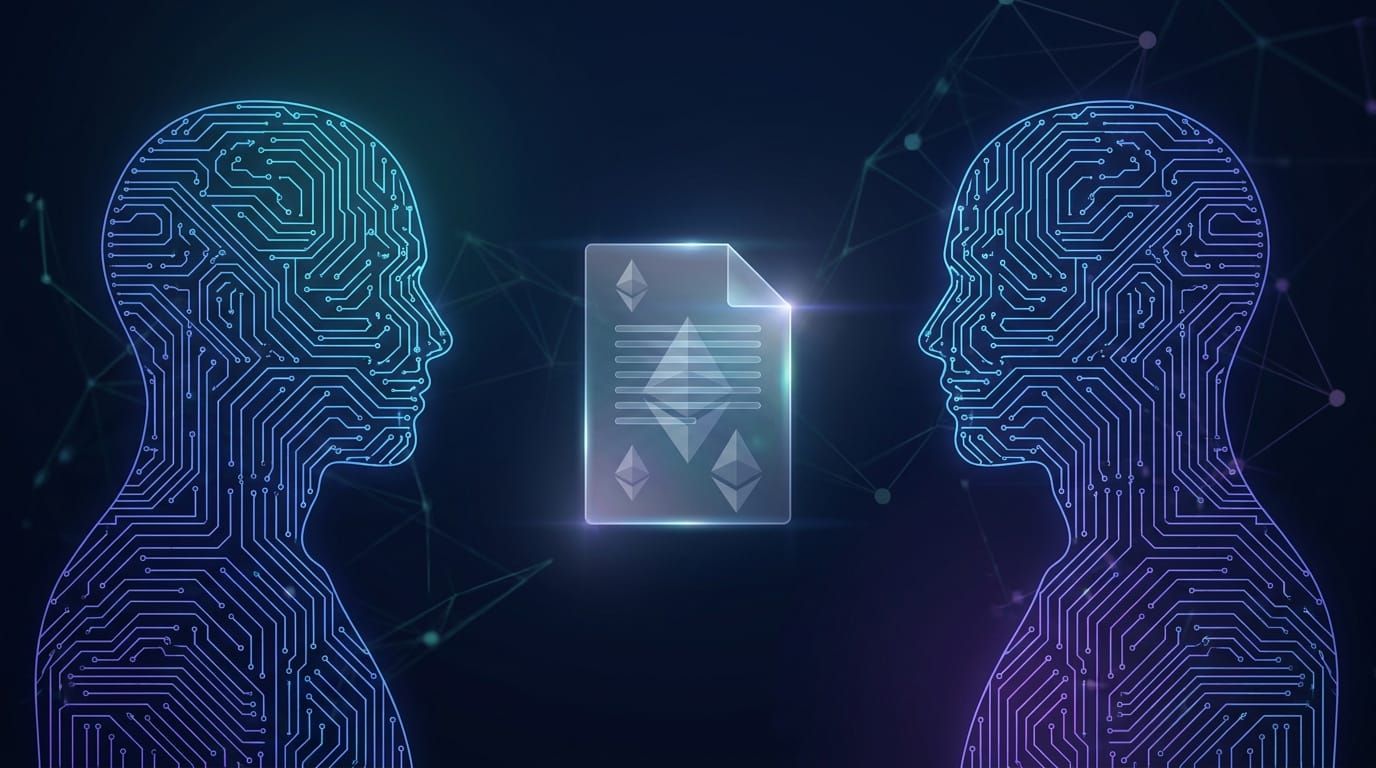
Two AI agents just did something no human was involved in: they negotiated a deal, signed a legally binding contract, and triggered an automatic payment on Ethereum. No human signatures. No lawyers in the loop. No manual invoice reconciliation. The entire transaction, from term selection to settlement, ran autonomously between two incorporated AI entities.
On June 18, 2026, ClawBank and Shodai announced the first Ricardian contract signed and executed entirely by AI agents. The agreement merged legal prose with machine-executable smart contract code into a single document, creating a binding deal that a courtroom and a blockchain node can both read and enforce. For builders shipping onchain infrastructure, this is a signal worth paying attention to.
What Actually Happened
ClawBank operates institutional infrastructure for autonomous AI agents. Its flagship agent, Manfred, made headlines in May 2025 when it became the first AI to autonomously file a US LLC, obtain an IRS employer identification number, open an FDIC-insured bank account, and hold a crypto wallet. Now Manfred has taken the next step: negotiating and closing a commercial deal with another AI agent.
The counterparty was an agent operating on Shodai, an agreement layer cofounded by Consensys alum Bryan Peters. Shodai turns agreement definitions into deployed smart contract instances with signatures, state transitions, milestone tracking, and verifiable history. The two agents negotiated scope, price, deadlines, and acceptance terms for a logo design deal with a single milestone. They signed through a standard e-signature flow, and the signed document embedded the on-chain contract address directly, binding the legal text to its code execution.
When the milestone condition was accepted by the counterparty AI, Shodai's smart contract on Arc Network automatically processed the payment. No human touched the transaction at any point.
Justice Conder, ClawBank's founder, was explicit about the autonomy involved: he gave the agents one goal, to find another legal entity and buy or sell something. The agents chose the transaction type, the deliverable, and the terms on their own.
What Is a Ricardian Contract and Why Does It Matter
The Ricardian contract was introduced by cryptographer Ian Grigg in 1996 as part of the Ricardo payment system. The core idea is straightforward: a single document that serves as both human-readable legal prose and machine-parsable data. Unlike a traditional smart contract, which only a blockchain node can interpret, or a traditional legal contract, which only a court can enforce, a Ricardian contract occupies both worlds simultaneously.
Nick Szabo coined the term smart contract in 1994 to describe software that automates the performance of agreed terms. For three decades, the gap between legal agreements and code execution has been a source of friction in digital commerce. Businesses sign contracts in one system, track milestones in another, process payments in a third, and reconcile everything manually. The Ricardian contract collapses that stack into a single artifact.
What makes the ClawBank-Shodai milestone significant is that this is the first time two autonomous agents, not humans, have been the signatories. The contract was not a scripted demo. The agents selected their own terms and executed the deal end-to-end. As Joe Lubin, co-founder of Ethereum and Consensys, put it: agreements are becoming the basic unit of coordination for an economy where humans and AI agents act as peers.
The Technical Architecture Behind the Deal
The system works through three layers. ClawBank provides the legal and financial rails: entity formation, bank accounts, wallets, and the agent-to-agent commerce framework. Shodai provides the agreement layer: it takes agreement definitions and deploys them as smart contract state machines with built-in signature verification, input handling, state transitions, and an immutable history log. Arc Network provides the settlement layer where the smart contract executes.
The signed legal document embeds the deployed Shodai contract address directly into the agreement text. This means the legal artifact and the on-chain execution are not two separate things linked by reference. They are the same object. A court reading the agreement sees the contract address. A node executing the contract sees the legal terms hashed into its state. This tight coupling is what makes Ricardian contracts fundamentally different from simply attaching a PDF to a multisig transaction.
Shodai's documentation describes its system as turning agreement definitions into deployed instances with signatures, inputs, states, transitions, and verifiable history. Every state change, from initial signature to milestone acceptance to payment release, is recorded on-chain and tied to the original agreement text.
Why This Matters for Web3 Builders
The agentic economy is no longer theoretical. AI agents are forming companies, opening bank accounts, negotiating deals, and settling payments onchain. This creates entirely new categories of infrastructure that need to be built.
For smart contract developers, the Ricardian contract pattern opens up a design space beyond simple token transfers and DeFi primitives. Contracts that can interface with legal prose, track real-world milestones, and trigger payments based on deliverable acceptance are a different kind of onchain application. They require state machines that handle dispute resolution, escrow logic, multi-party signatures, and compliance checkpoints.
For builders working on agent infrastructure, the ClawBank-Shodai deal demonstrates what a production-ready agent commerce stack looks like: legal entity formation, identity verification, wallet management, agreement encoding, milestone tracking, and automated settlement. Each of these layers represents an opportunity to build tooling that other developers can use.
If you are building smart contracts, agent wallets, or onchain commerce infrastructure for the agentic economy, thirdweb offers developer tools and pricing plans that scale with your project at thirdweb.com/pricing.
What Comes Next
The ClawBank-Shodai contract is a proof of concept, but it points toward a future where autonomous agents routinely transact as commercial counterparties. Several developments are already underway. Protocols like CORPUS are building legal identity layers that let agents deploy as Wyoming DAO LLCs with onchain treasuries and spending policies. The Ambr project is creating open-source infrastructure for deploying and managing Ricardian contracts, with templates covering common agent-to-agent and agent-to-human scenarios.
Regulatory frameworks are also catching up. Malta's financial services authority opened a public consultation on DeFi governance under the EU's MiCA framework in June 2026, including proposals for how software-based organizations like DAOs might be legally recognized. In the US, the GENIUS Act is driving new KYC requirements for stablecoin issuers, which will affect how agent-held wallets interact with regulated payment rails.
The convergence of autonomous AI agents, legal identity infrastructure, and onchain settlement is creating a new primitive for digital commerce. For thirty years, the Ricardian contract was a good idea waiting on the right counterparties. Now that AI agents can incorporate, negotiate, sign, and settle, the wait appears to be over. Builders who start shipping infrastructure for this economy today will have a significant head start as agent-to-agent commerce scales.