
MEV on Ethereum: How $2M Vanished in One Block
A $2M same-block backrun exploit shows why MEV defense is non-negotiable for DeFi builders. Learn the supply chain, PBS architecture, and mitigation patterns.

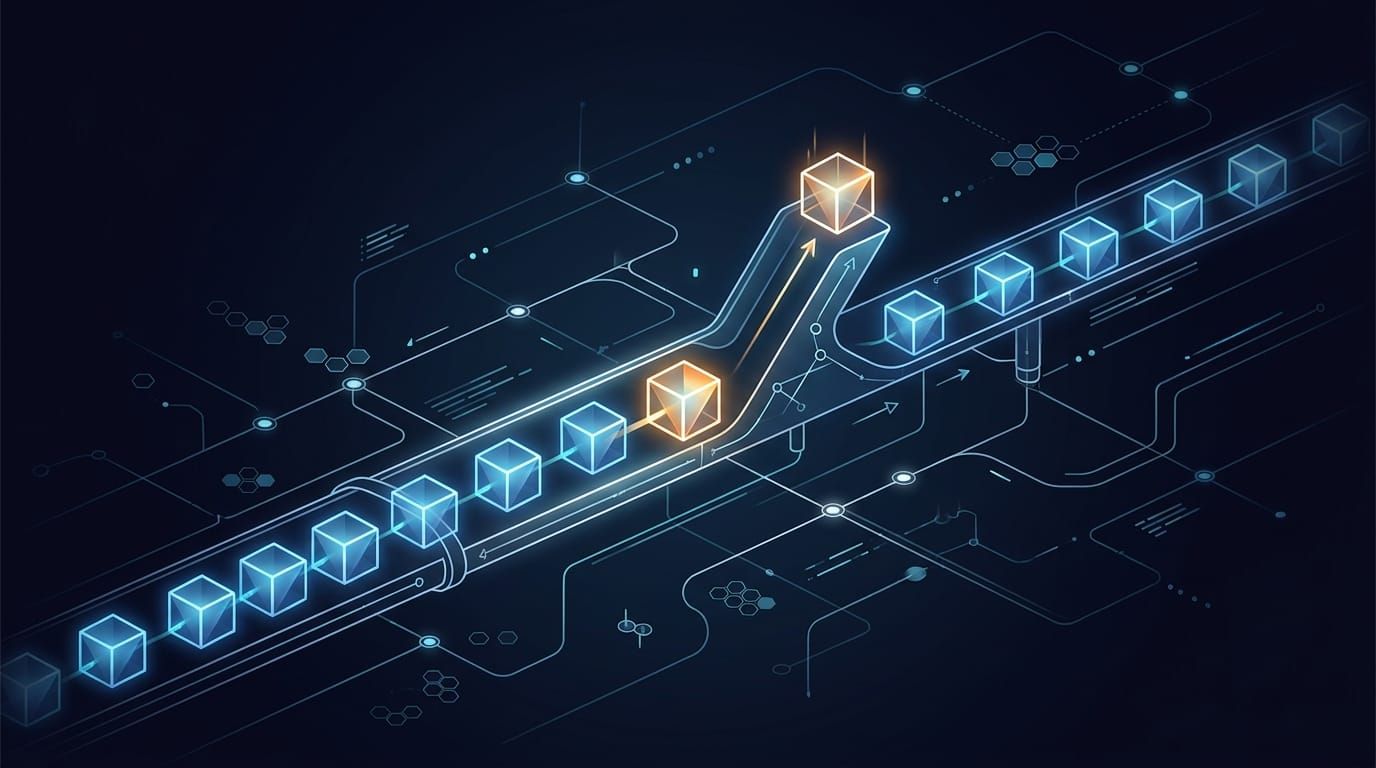
On Monday, July 7, 2026, a Uniswap v3 trader clicked confirm on what looked like a routine swap. They sent 1,126.44 ETH into the transaction — roughly $2.01 million at the time. What came out the other side was about $14,500 worth of LIT tokens. Total loss: 99.3%.
No smart contract was hacked. No private key was compromised. No validator misbehaved. The transaction executed exactly as the trader requested. Uniswap v3 did its job. The router did its job. The block was assembled by a validator following protocol rules. And yet, $1.8 million flowed directly to Titan Builder as a block-builder reward.
This was not theft in the traditional sense of an exploit. It was a same-block backrun extraction — a form of Maximal Extractable Value (MEV) that exists because Ethereum's block production pipeline is designed to reward whoever assembles blocks most profitably. Titan Builder, which controls roughly 55% of Ethereum's block production, has earned $112.6 million in builder revenue in 2026 alone. This single trade added $1.8 million to that total.
For DeFi developers, the lesson is stark: MEV isn't a protocol bug on the way to being fixed. It's a structural feature of how public blockchains price blockspace. And if your application doesn't defend against it, your users are the ones paying the tax.
The MEV Supply Chain: Searchers, Builders, and Block Producers
To understand how a legitimate swap became a $2M loss, you need to understand the four-layer pipeline that produces every Ethereum block today.
At the bottom are searchers — algorithmic agents that scan the public mempool for profitable opportunities. They identify pending trades, calculate the price impact those trades will create, and submit their own transactions designed to extract value from the resulting price movements. Searchers do not build blocks; they find profitable input for builders.
Builders, the second layer, aggregate transactions from searchers, the public mempool, and private order flow. Their job is to assemble the most profitable block possible, ordering transactions to maximise extractable value. Builders submit their assembled blocks to relays, the third layer, which serve as trusted intermediaries that hold blocks in escrow and reveal them to validators only after the proposer commits to the slot.
At the top sits the proposer — a validator selected by Ethereum's consensus mechanism to propose the next block. The proposer receives assembled blocks from multiple builders via relays, selects the highest-bidding one, and proposes it to the network. The proposer collects the builder's bid as a tip, and the builder keeps whatever MEV it extracted during assembly.
This architecture, known as Proposer-Builder Separation (PBS), was introduced after the Merge to prevent validators from needing specialised trading infrastructure to compete. It succeeded at that goal — median validator revenue from PBS blocks jumped 104% post-Merge — but it created a new problem: whoever controls block assembly captures the MEV. And block assembly, it turns out, concentrates around a very small number of firms.
Anatomy of the $2M Backrun: What Actually Happened
The Titan Builder extraction was not a sandwich attack, despite much of the initial reporting getting this wrong. A sandwich attack requires two transactions — one placed before the victim's trade (buying the asset the victim is about to buy) and one after (selling into the elevated price). The searcher wraps the victim on both sides.
A same-block backrun, by contrast, needs only one transaction, executed after the victim's. When the trader's 1,126 ETH swap hit a low-liquidity AVAIL/WETH pool, it mispriced the pool by orders of magnitude — receiving nearly 6.67 million AVAIL tokens at a wildly inflated price. The router then sold a small amount of externally sourced AVAIL into the same pool to extract approximately 1,072 WETH. An arbitrage trade executed in the same block pushed the pool back to fair value, and the difference — 1,018 ETH, worth $1.8 million — went to Titan Builder as its reward.
As security firm GoPlus Security put it in their post-mortem: "This was a real, highly imbalanced backrunner arbitrage, not a classic sandwich attack." The trader's loss did not vanish — it moved, reappearing as builder revenue in the same block. No front-running occurred. Only same-block cleanup of the wreckage the victim's own routing left behind.
This distinction matters for builders. Sandwich attacks are mostly solvable with private mempools like Flashbots Protect or MEV Blocker. Same-block backruns require deeper protections: liquidity-aware routing, aggressive slippage settings, and routers that refuse to send 99% of a $2M order into a pool with a $10,000 TVL. The trader's front-end failed them long before any searcher became involved.
The Predator Becomes Prey: The $7.5M JaredFromSubway Honeypot
If the Titan incident shows what MEV extraction looks like from the victim's side, the JaredFromSubway incident from June 20 illustrates a different dynamic: the MEV bots themselves are not safe.
JaredFromSubway was one of the most active MEV bots on Ethereum, running automated sandwich and arbitrage strategies. On June 20, an attacker drained approximately $7.5 million in WETH, USDC, and USDT from the bot using a counter-MEV honeypot — an attack that turns an automated bot's own profit-seeking logic into the mechanism that drains it.
The attacker built 66 fake liquidity pools with impostor tokens, each designed to look like a legitimate trading opportunity. The pools were rigged so that when the bot took what appeared to be profitable trades, it unknowingly granted token approvals to attacker-controlled contracts. Those approvals sat open, unrevoked, across all 66 fake-token contracts. Once enough approvals had accumulated, the attacker swept the bot's holdings in a single transaction.
Blockaid CTO Raz Niv described it as a "counter-MEV honeypot" — structurally distinct from every other DeFi exploit this year. "The attacker did not break the bot," Niv wrote. "The attacker convinced the bot to break itself." It's a reminder that MEV is an adversarial environment at every level of the stack, not just between bots and users, but between bots and other bots.
Enshrined PBS and Glamsterdam: The Protocol's Answer
Ethereum's core developers have been aware of builder centralization for years. Titan Builder alone assembles roughly 55% of Ethereum blocks, and Titan plus Beaverbuild together historically build around 90%. The Glamsterdam upgrade, currently in testing on public testnets, aims to address this with EIP-7732: Enshrined Proposer-Builder Separation (ePBS).
ePBS moves the block-builder auction from an out-of-protocol construction — the MEV-Boost middleware and external relays like Ultra Sound Relay — into the consensus layer itself. Instead of trusting third-party relays to mediate between proposers and builders, the protocol uses native cryptographic commitments. The goal is to eliminate the operational leverage that the current relay and builder oligopoly holds.
But developers should be clear-eyed about what ePBS does and doesn't do. It reduces trust assumptions around relays, and it may modestly reduce barriers to entry for new builders. But it does not eliminate MEV. It does not prevent sandwich attacks. It does not stop a trader from routing a $2M swap into a $10,000-TVL pool. As Ethereum Foundation researchers have noted, ePBS "mathematically optimizes the extraction of MEV; it doesn't prevent it."
The block-building game will remain low-latency, high-capital, and MEV-sophisticated regardless of whether the auction lives in-protocol or out. The firms with the best latency, largest inventory, and deepest searcher networks will still win most slots. Protocol change can prevent censorship and forced-ordering, but it cannot change the economics of who profits from assembling blocks.
What DeFi Builders Can Do: A Defense Playbook
If protocol-level changes cannot eliminate MEV, the defense has to happen at the application layer — in the routers, aggregators, and smart contracts that sit between users and the block builder. Here are the tools that work today.
First, enforce strict slippage and liquidity-aware routing. The Titan victim's swap routed 99% of the order into a pool with negligible TVL. A router designed to reject low-liquidity pools for whale-size trades — like 1inch's Pathfinder or Uniswap X — would have refused to route that trade at all. Builders should treat liquidity-awareness as a core product requirement, not an optional optimization.
Second, use private mempools. Flashbots Protect, MEV Blocker, and private RPC endpoints prevent transactions from being visible in the public mempool before inclusion. This does not block same-block backruns — the builder still sees the transaction — but it does prevent the cross-transaction visibility that makes exotic sandwich wraps easier. For most retail trades, private mempools are the simplest and most effective defense.
Third, break large orders into smaller pieces. A $2M swap has no business being executed as a single atomic transaction into anything except the deepest liquidity venues. Two-decade-old TradFi execution algorithms know this. DeFi front-ends, for the most part, still do not. Implement TWAP-style execution — splitting large orders into smaller chunks executed over multiple blocks — to reduce the price impact that makes backrun extractions profitable.
Fourth, adopt intent-centric architectures. Platforms like CoW Protocol flip the execution model: instead of specifying an exact execution path, users sign a declarative message stating their constraints. Professional solvers then compete in batch auctions to find the optimal settlement, including peer-to-peer matching that bypasses AMM pools entirely. No pool interaction means no sandwich attack surface. Trades for the same token pair in the same batch clear at the same price, destroying the fundamental premise of front-running.
Fifth, for protocols building on Uniswap v4, leverage hooks strategically. A beforeSwap hook can monitor for toxic order flow and dynamically spike fees when it detects aggressive directional sizing, destroying the MEV bot's profit margin and redistributing the penalty to liquidity providers. But hooks are also a security minefield — every custom hook requires a dedicated audit, and dynamic logic hooks are particularly vulnerable to oracle manipulation and delta accounting errors.
The Rails Work. The Wrappers Need to Catch Up.
Every component of the Titan Builder extraction was behaving within its designed parameters. Ethereum's protocol worked as advertised. The block-space market is competitive at the builder layer — and the equilibrium outcome of that competition is that a single firm assembles more than half of all blocks and earns nine-figure annual revenue from MEV extraction.
The IMF captured this bluntly in its July 8 working paper on tokenized financial market infrastructure: "MEV is an inherent feature of public blockchain design in its current form." This is not a bug the protocol can patch out. It is a structural consequence of how blockspace is priced in a permissionless system.
But while the protocol cannot prevent MEV, the application layer can dramatically reduce user exposure to it. Liquidity-aware routing, private mempools, order splitting, intent architectures, and strategically deployed hooks are all available today. They require deliberate engineering, not protocol votes.
As the Titan incident makes clear, the largest risk to DeFi users right now is not protocol failure — it's application-layer failure to protect against the extraction dynamics that the protocol was designed to reward. Builders who close that gap will have the competitive advantage. Builders who ignore it will keep sending their users' money to Titan, one block at a time.
If you're building DeFi applications, thirdweb's developer platform gives you the infrastructure to deploy secure, MEV-aware smart contracts across multiple chains — with built-in tools for testing slippage boundaries, simulating adversarial order flow, and integrating private mempool providers. Check out the plans at thirdweb.com/pricing to see what fits your team.